Showing posts with label Darwin. Show all posts

Saturday, February 12, 2011

Darwin Day: Much Ado About Nothing

Groundhog (Marmota monax), Ottawa, Ontario                                  Image via Wikipedia
It's Darwin Day, woodchuck-chuckers!

Probably a good day to pull out this:

In the Beginning was Nothing: A Creation Story for Young Materialists -- by Joe Carter

Darwin put us on a par with bugs, freed us from God, and undercut the philosophical underpinnings of meaning, purpose, values, destiny, and hope, in other words, everything that makes us authentically human -- yeah, Darwin!!!
Enhanced by Zemanta

Friday, September 03, 2010

Quote of the Day: "Talk about Malthus and Darwin until it sinks into the stupid people's brains!!"

The Discovery ChannelImage by icantcu via Flickr

"Develop [Discovery Channel] shows that mention the Malthusian sciences about how food production leads to the overpopulation of the Human race. Talk about Evolution. Talk about Malthus and Darwin until it sinks into the stupid people's brains until they get it!!" -- James J. Lee, Discovery Channel madman.

If this ideologically obsessed man's motivation were Catholicism or evangelical Christianity instead of Al Gore's Inconvenient Truth, do you think the media would have failed to bring this to the public's attention?


Instead, the mainstream media takes a pass.
Enhanced by Zemanta

Thursday, August 19, 2010

Quote of the Day: "There is more to life than the laws of chemistry and physics." -- Scot McKnight

To Kill a MockingbirdImage via Wikipedi
Is atheism "less than there is" -- or is theism "more than there is"?

Is atheism reductionist? Does it fail to recognize layers of explanation?

Is there a direction and a "plot" to the universe, or is the elegant unfolding of the universe since the Big Bang just a crazy outcome of a purposeless explosion?

Scot McKnight reviewing John F. Haught's book  Making Sense of Evolution: Darwin, God, and the Drama of Life:
There is, Haught suggests, a direction and a purpose to creation, but we will not see the intent and direction at the level of chemistry and physics any more than we see the intent in To Kill a Mockingbird at the level of grammar and spelling. Even less will we see the meaning at the level of the chemistry of paper and dyes, the engineering of the printing press, or the materials chemistry behind the electronic ink or electronic paper of a Kindle or Nook or other e-reader....
I am not a theist because I find gaps in the grammar and spelling that require direct action of God - I am a theist because I believe in a plot, purpose, and direction that transcends the nuts and bolts of the grammar and spelling. There is more to life than the laws of chemistry and physics.
How about you -- do you believe in a plot, purpose, and direction to life?

To your life?

Regain your humanity. Make the existential leap. Rebel against the atheist machine.™

Read more.
Enhanced by Zemanta

Tuesday, August 17, 2010

Quote of the Day: "This Very Old Argument Against The Existence Of An Intelligent First Cause""

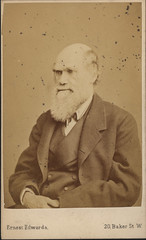
Portrait of Charles Robert Darwin (1809-1882),...Image by Smithsonian Institution via Flickr
“A being so powerful and so full of knowledge as a God who could create the universe, is to our finite minds omnipotent and omniscient, and it revolts our understanding to suppose that his benevolence is not unbounded, for what advantage can there be in the sufferings of millions of the lower animals throughout almost endless time? This very old argument from the existence of suffering against the existence of an intelligent first cause seems to me a strong one; whereas….the presence of much suffering agrees well with the view that all organic beings have been developed through variation and natural selection.” -- Charles Darwin.

Darwinism -- theology, philosophy, science, or, combo plate?

You decide.

* * *

 Implicit in Darwin's view of nature is the notion that variation and natural selection are unplanned, purposeless processes. Darwin's nature requires at most a deist God -- uninvolved in the outworking of life. This underlying philosophical assumption sits on the border between science and theology.

Darwinists continue to make theological arguments in science articles and textbooks similar to this one made by Darwin. Which brings into question the alleged neutrality of science and scientists in matters of theology and philosophy.

Unlike the low-rent-God of the deist, or the no-rent god of the atheistic scientist, the theist looks beyond the merely empirical to empiricism's sufficient cause -- why there should be a universe at all, why there should be this particular universe -- orderly, structured, empirical and fine-tuned for life, one that submits itself to orderly, structured empirical inspection, and why there should be purposeful, rational, morally oriented creatures uniquely capable of performing such inspection, i.e., "us". The only sufficient answer for the Christian is "because God, and man created in God's image".
Enhanced by Zemanta

Thursday, July 22, 2010

More on the Darwin - Alfred Russel Wallace Controversy

Extracts from a current paper on the Darwin - Wallace Controversy.

"Though Darwin never acknowledged the Sarawak Law paper [1855], a graduate student, Lewis McKinney (1966) found a copy of it in his collected papers. It had been heavily annotated by Darwin who had obviously recognized its importance....

* * *

"... This completed Wallace’s theory of evolution; he wrote it out and posted it to Darwin from the island of Ternate on 9 March [1858] when the first available ship arrived. McKinney (1966) has drawn attention to another letter, which still exists, and was sent by Wallace on the same boat, on the same day, to Frederick Bates (figure 3). The letter corroborates the dates of posting; it carries the cancellation marks for the various stages of its journey from Ternate and arrived in the Leicester post office for delivery on 3 June.

"The letter to Darwin should therefore have been delivered on the same day or very soon after, but he claimed not to have received it until 18 June. The fact that he had, in the meantime, written to Hooker on 8 June to say that he had finally solved the frustrating problem of how species diverged in nature, looks a little suspicious in these circumstances.

* * *


"That Wallace almost certainly solved the problem of divergence before Darwin did is, perhaps, not surprising. Wallace had much the greater experience in the field of biogeography, which was so fundamental to unravelling the relationships between species. But, even more importantly, he had the advantage that, unlike Darwin, he was looking actively for evidence of evolution while in the field, and
could therefore tailor his data collection appropriately.

* * *


It appears [i.e., it's not proven] that Wallace's contributions enabled Darwin to overcome his conceptual logjams and provided him with some key insights that were integral to his theory as finally published subsequent to Wallace's published papers and letters to Darwin.  Darwin finally acknowledged Wallace, but not in the first edition of the Origin, and not in its second.

Extracted from J. Biosci. 35(3), September 2010 ePublication: 30 June 2010
DAVID LLOYD*, JULIAN WIMPENNY and ALFRED VENABLES

"... nothing intellectually compelling or challenging.. bald assertions coupled to superstition... woefully pathetic"