Showing posts with label science. Show all posts

Tuesday, November 15, 2011

Quote of the Day: "The dispute between atheism and theism is at bottom a philosophical dispute, not a scientific one"

Coat of arms of RosenbergImage via Wikipedia
Continuing our look at Alex Rosenberg’s The Atheist’s Guide to Reality, we come to Rosenberg’s treatment of the question “Where did the big bang come from?”....
"[T]he dispute between atheism and theism is at bottom a philosophical dispute, not a scientific one." -- Edward Feser, in the combox of the above post, here.

Wednesday, August 10, 2011

Origin Of Life: Solved!!!

Gas proportions in the Earth's atmosphere.Image via Wikipedia
A few days ago we solved the origin of the universe problem.

Now the Ball Bounces turns its lonely eyes to you turns its attention to the problem of the origin on life. How hard can it be, really? I mean, it took literally nothing to solve the origin of the universe problem.

To get life, simply add nowhere to nothing. Nothing plus nowhere (plus chance -- ya gotta have chance in your corner) = Life!

This is how it happens: Information necessary for life simply appears out of nowhere, by chance. There. Problem solved. Did you get that? Let me say it again. Embedded, communicated information -- you know, the kind of thing we normally associate with intelligence  random occurrence, simply appears out of nowhere, by chance.

It's simple. It's elegant. Do I win a Nobel?

Drat -- somebody beat me to it:
We can now address a simple question that is central to our understanding of the origin of life: Can non-living systems evolve? Can genetic information really appear out of nowhere, by chance? If the answer is no, then we're in trouble because those of us who work on the origin of life claim that is exactly what happened four billion years ago, when the first forms of life emerged from a sterile mixture of minerals, atmospheric gases, and dilute solutions of organic carbon compounds. 
The answer has to be yes, because otherwise we are looking at intelligence. Article in Evolutionary News and Views that brings this to our attention, here.

The exciting news is this: with this breakthrough, scientists have at long last reconciled materialism with God, and even come up with a scientific description of the Creator!!! OK, he's a bit stubby and truncated, but here He is, God according to the latest scientific theory:

He's a real Nowhere Man,
Sitting in his Nowhere Land,
Making all his nowhere plans
for nobody.
Making all his nowhere plans
for nobody.
Making all his nowhere plans
for nobody!
Where did DNA information come from? Science circa 2011: Nowhere, man.Enhanced by Zemanta

Saturday, August 06, 2011

Life Blooms On Mars!!!

Solar system   Image by Mads Boedker via Flickr
"You bloom quickly, you do what you need to do, and you go dormant." -- description of life on Mars, based on "the science" circa 2011

Life on Mars? Yikes, this sounds like life on earth!

The evidence for this?

To paraphrase scientist Dr. Emmett Brown, "Evidence? Where we're going, we don't need evidence".

Or, as an eminent Mars explorer once put it, "To infinity ... and beyond!

Evolution News and Views has the full story.
Enhanced by Zemanta

Saturday, July 23, 2011

My Gut Tells Me This Is Wrong...

H&E staining of sagittal section of 10 days ol...                                        Image via Wikipedia
UK Mail Online:
Scientists have created more than 150 human-animal hybrid embryos in British laboratories.
The hybrids have been produced secretively over the past three years by researchers looking into possible cures for a wide range of diseases. 
Figures seen by the Daily Mail show that 155 ‘admixed’ embryos, containing both human and animal genetic material, have been created since the introduction of the 2008 Human Fertilisation Embryology Act. 
This legalised the creation of a variety of hybrids, including an animal egg fertilised by a human sperm; ‘cybrids’, in which a human nucleus is implanted into an animal cell; and ‘chimeras’, in which human cells are mixed with animal embryos. 
Human-animal hybrids? It's crunch-time, folks. Are we crossing a line? Are we exceptional, or are we not? Are human beings merely, as darwinists and atheists like David Suzuki insist, mere animals, no better, no worse, and nothing more? And if all creation is by accident and not by design, with no externally-imposed, objective right-and-wrong, good-and-bad underlying human existence, why not?

So, here's the question. Is there, or is there not, a line here that can be crossed? I'm listening to my gut -- what does yours say? Sometimes inward intuition is a source of knowledge. Meanwhile the atheist empiricist can only protest, "where's the evidence?".

The evidence? It's in the intuitions of the human heart. What's left is for us to figure out whether these intuitions of human exceptionalism were implanted as a cruel trick of mindless evolution, or by a purposeful Creator.

Regain your full humanity. Rebel against the atheist machine.™

And that's the way the Ball bounces.

h/t Drudge.

Related articles

Tuesday, June 14, 2011

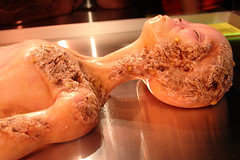
Alien Arsenic-Boy Is So Last Year

The Science of AliensImage by MJ/TR (´・ω・) via Flickr
 Last December we reported on a controversial paper published in Science which claimed to have discovered bacteria that feed on arsenic instead of phosphorous. According to NASA, this research promised to provide "an astrobiology finding that will impact the search for evidence of extraterrestrial life." At that time the media reported things like:

  • scientists discovered "a bacteria whose DNA is completely alien to what we know today" (Wired)


  • the "bacteria is made of arsenic" (Wired)


  • the bacteria is "capable of using arsenic to build its DNA, RNA, proteins, and cell membranes" (Gizmodo)


  • the paper had reported "arsenic-based life" which is "very alien in terms of how it's put together" and "NASA has, in a very real sense, discovered a form of alien life" (io9)


  • "you can potentially cross phosphorus off the list of elements required for life" (Nature)


  • But soon after the original Science paper was published, credible scientists began critiquing the paper's claims....

    Enhanced by Zemanta

    Sunday, May 08, 2011

    Do These Religious Assertions Belong In Science Class?

    Phillip Johnson and intelligent design profile...Image by Raymond Yee via Flickr
    Do the following religious assertions belong in science class?

    1. Human begins are not justfied in believing that God creates in ways analogous to the intellectual powers of the human mind.

    2. A God who is free to create as He wishes would create new biological limbs de novo rather than from a common pattern.

    3. A respectable deity would create biological structures in accord with a human conception of the 'simplest mode' to accomplish the functions of these structures.

    4. God would only create the minimum structure required for a given part's function.

    5. God does not provide false empirical information about the origins of organisms.

    6. God impressed the laws of nature on matter.

    7. God directly created the first 'primordial' life.

    8. God did not perform miracles within organic history subsequent to the creation of the first life.

    9. A 'distant' God is not morally culpable for natural pain and suffering.

    10. The God of special creation, who allegedly performed miracles in organic history, is not plausible given the presence of natural pain and suffering.

    Yes?  Click here for the implications.

    Related articles

    Wednesday, April 06, 2011

    Quote of the Day: "People who don’t believe the Bible..."

    "I find that people who don’t believe the Bible are more impressed with the Bible when I start by arguing with the scientific evidence." -- Wintery Knight.

    An interesting take on apologetical method by the Wintery One discussing J. P. Moreland article on the scientifically-validated deleterious effects of promiscuity.

    From a preaching point of view, the approach would be the opposite, i.e., preach the word, and illustrate by scientific confirmation.

    And the beat goes on...

    h/t Dan Hannon for pointing out the mis-attribution of the quote in the original post.


    Enhanced by Zemanta

    Monday, November 08, 2010

    Quote of the Day: "The real issue is not whether a theory is ‘scientific’, but whether a theory is true”

    Science icon from Nuvola icon theme for KDE 3.x.            Image via               Wikipedia
    [Stephen] Meyer explains that “... philosophers of science have increasingly realized that the real issue is not whether a theory is ‘scientific’ according to some abstract definition, but whether a theory is true, or supported by the evidence.” -- Bill Pratt, Tough Questions Answered.
    Enhanced by Zemanta

    Wednesday, October 27, 2010

    Bacteria

    Flagellum of Gram-negative Bacteria. The base ...                                       Image via Wikipedia
    Think bacteria are a primitive form of life?

    Think again.

    Chemical language. "Quorum sensing". A world of complexity.

    Darwinian worldview quote: "bacteria invented this".  Hmmmm.

    A superb video.

    h/t Evolution News & Views.


    Enhanced by Zemanta

    Thursday, September 30, 2010

    Scientists Use Giant Fudge to Seek Shower Mould on Goldilocks

    Habitable zone relative to size of stars                     Image via Wikipedia
    "Personally, given the ubiquity and propensity of life to flourish wherever it can, I would say, my own personal feeling is that the chances of life on this planet are 100 percent," said Steven Vogt, a professor of astronomy and astrophysics at the University of California, Santa Cruz, during a press briefing today."


    "I have almost no doubt about it."

    Well, yes. But he's using Giant Fudge to search for Shower Mould on Goldilocks, so he would say that, wouldn't he?!


    Read the latest in the quest for life on other planets here.
    Enhanced by Zemanta

    Friday, September 03, 2010

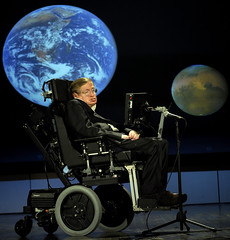
    Stephen Hawking Jumps The Shark

    Stephen Hawking NASA 50th (200804210002HQ)Image by nasa hq photo via Flickr
    Stephen Hawking jumps the shark:

    "Because there is a law such as gravity, the universe can and will create itself from nothing. Spontaneous creation is the reason there is something rather than nothing, why the universe exists, why we exist"  -- Stephen Hawking.

    This is the best that one of the greatest minds on the planet has to offer?  Maybe it gets better if you read everything he said; but this is incoherent on about every possible level.

    For starters:

    * If there is really and truly nothing, then where does gravity come from?

    * Why do natural laws exist at all, and why  are the natural laws what they are as opposed to some other thing?  Why, e.g., is there gravity in the first place, and why does it have the strength it has as opposed to some other strength?

    * The terms spontaneous creation and reason are incoherent when used together. If creation was spontaneous, then there may be a cause for the universe but there is no reason for it;  reason becomes an incoherent concept and an absurd quest. Spontaneous generation of the universe may explain how we came to exist, but not why -- because there can be no why under this scenario.

    Hawking's comment appears to be nothing more than atheist dogma -- "from nothing, by nothing, for nothing" -- in pseudo-scientific drag.

    Stephen's wife, Jane, here.

    Related articles by Zemanta
    Enhanced by Zemanta

    Monday, August 30, 2010

    "You Prepare A Table Before Me"

    The first few hydrogen atom electron orbitals ...Image via Wikipedia
    Ball Bounces contributor PatJ's take on fine-tuning:
    The universe is 880,000,000,000,000,000,000,000,000 metres across, and in all of it, there is one tiny spot, a region less than 4,000m thick on the surface of a tiny sphere, where you could survive (most of that surface covered by water that would drown you in minutes, so cold you would freeze to death in an hour, or so dry you would desiccate in days). The rest of the universe is dominated by extremely dissociated hydrogen gas, and bombarded by cosmic rays. (There may be other, similar small areas where you could survive, but none within a reachable distance, of course). But that only accounts for less than 5% of the universe mass, as most is less ordered than the hydrogen atom. The universe is at least 13,750,000,000 years old, our sun less than 5,000,000,000 years, the planet only slightly younger, and an atmosphere with sufficient oxygen that you do not asphyxiate instantly less than 2,500,000,000 years. Your oldest relatives that could even loosely be termed “hominid” developed less than 2,000,000 years ago. Your religion was invented less than 2,000 years ago, and you, I suspect, are less than 100 years old. 
    So less than a billionth of a billionth of a billionth of the universe is habitable by you, and your life span is a billionth of the life span of the universe. But somehow it is all about you. How self-deluded and self-important do you have to be?
    My response:

    First, I want to thank PatJ for his contribution, and commend him for his knowledge of science.

    As usual, it is not the facts on the table, but how they are interpreted (and why there is a table in the first place!).

    The facts presented are entirely in keeping with a God who is a) Big, i.e., operates on a scale that is unimaginably bigger than we are, b) in no hurry, i.e., has all the time in the world since he made both the world and time itself, and, c) wanted to give us something marvel-worthy.  Even atheists agree that the heavens are a marvel.

    As for it being about "me".

    It's not about "me", but the marvel that there is a "me", i.e., a self-conscious soul peeking out of the molecules to do the marvelling.

    It's about Christ, the Logos, by whom all things were made, who sustains the universe moment by moment, and for whom all things were made.

    Now, I cannot help the fact that God loved this world wrecked by sin -- that's his choice, not mine. But, I'm not going to let that stop me from signing-on to his offer and program, as countless others have done and will I trust yet do.

    In the book of Revelation there is a wonderful picture of the countless multitudes who have washed their robes in the blood of the Lamb, and who have thus been made worthy of God Himself.  They are engaged in the wonder not merely of creation but also of redemption. The gospel is not just praise-worthy, when properly understood, it is gasp-worthy. One of the things I like to say about it is that it is "too good not to be true", by which I mean, no human would or could invent such a story of human unworthiness and divine sacrifice and all the paradoxes and table-turning that takes place at the Cross.

    I don't know how many are in the countless multitudes standing washed in the blood of the Lamb, but we are well on our way to reaching the quota. Let's not forget that when this prophecy was given, Christianity was, as its critics are wont to point out, an obscure, insignificant movement that numbered in the hundreds or low thousands at most -- so insignificant that it barely, but just, shows up in official records of the day.  A pretty brave prognosis by the politically powerless John exiled on the Isle of Patmos for the word of God.

    And yet his prophecy is all part of the arrow of divine purpose launched in Genesis and which culminates in the book of Revelation -- a narrative in whose shadow we all live our lives, whether wittingly or unwittingly, willingly or unwillingly.

    So, no, it's not about me. I didn't make the table, and I didn't set the table. But that doesn't mean I'm not going to eat what's on the table.
    Enhanced by Zemanta

    Sunday, August 29, 2010

    Quote of the Day: "What is at issue is not what reputable biologists believe, but whether it is true"

    It is precisely the reputable biologists who are under attack. For the first time, they are being asked to defend the thesis that biological design is more apparent rather than real. The effort has left them breathless. They are, of course, not about to surrender their ideological allegiances. Their rhetoric fills the op-ed columns of every liberal newspaper and is conveyed additionally by academic allies whose welfare is contingent on theirs -- analytic philosophers, pop psychologists, and even newspaper columnists eager beyond measure to do anything but attentively study the evidence.

    But what is at issue, of course, is not what reputable biologists believe, but whether it is true.
    David Berlinksi, Academic Extinction.

    Enhanced by Zemanta

    Thursday, August 26, 2010

    Quote of the Day: "It’s Infinitely More Complex”

    A colony of embryonic stem cells, from the H9 ...Image via Wikipedia
    “When we started out, the idea was that signalling pathways were fairly simple and linear,” says Tony Pawson, a cell biologist at the University of Toronto in Ontario.  “Now, we appreciate that the signalling information in cells is organized through networks of information rather than simple discrete pathways.  It’s infinitely more complex.” -- Tony Pawson

    There is an elegantly simple Solution to this infinite complexity.

    In the beginning was the Word.

    Regain your humanity. You are wonderfully made in God's image. Rebel against the atheist machine.™


    Enhanced by Zemanta

    Wednesday, August 25, 2010

    Quote of the day: "“If you don’t want God, you’d better have a multiverse.”

    Cyclic progressions of the universeImage via Wikipedia
    “If you don’t want God, you’d better have a multiverse.” -- Bernard Carr

    With the sheer improbability of the fine-tuning of the universe for life, the multiverse is the only game in cosmic-town.

    h/t Tom Gilson, “A Universe Built For Us”.
    Enhanced by Zemanta

    Monday, August 23, 2010

    Quote of the Day: "A Cell full of Info-rich Molecules, in a Universe with Info-rich Laws"

    Self-Assembled DNA Nanostructures. (A) DNA “ti...Image via Wikipedia
    "No organism grows from just a strand of DNA. DNA is always situated in an environment--a cell full of info-rich molecules, in a universe with info-rich laws of physical properties of matter and energy." -- Steve Potter, Information Layering.  h/t P@J.

    Information-rich molecules embedded in a universe filled with information-rich laws.

    Sounds good to me.

    In the beginning was the Word.
    Enhanced by Zemanta

    Friday, August 20, 2010

    Fine-Tuning and "The Big Fluke"

    The highest quality resolution version of this...Image via Wikipedia
    Is the universe fine-tuned for life?


    Let's say you found four metal rods on the ground as you walked along the beach. Different sizes. You strung them, banged on them, and they "just happened" to play a C chord - C-E-G-C.  


    Beautiful!  What are the odds of that, you might think?!


    Now imagine you went out collecting more rods. You strung them all together, as you found them, and, to your amazement, found that they played the notes to Beethoven's Ode to Joy. 


    What are the odds of that ??!!


    Infinitely better than the odds that the parameters of the universe we inhabit "just happened along" and each "just happened" to be within the range of narrow constraints that would permit life to arise.


    This is what is called the fine-tuning argument for the existence of God. As with origins of life (OOL), people who write about it use the word "fluke" to describe it. (If this keeps up, we may need to cut to the chase and call the Big Bang The Big Fluke.)


    As we begin our primer on fine-tuning, let's start with a Wikibit of facts:
    Martin Rees[6] formulates the fine-tuning of the universe in terms of the following six dimensionless constants:
    Now let's expand to 34 fine-tuned parameters. Evidence for the Fine Tuning of the Universe by Rich Deem.


    Hugh Ross of Reasons To Believe has compiled a list of 140 fine-tuned parameters, but, who's counting.


    Finally, let's take a look at a scholarly perspective -- THE FINE-TUNING DESIGN ARGUMENT:
    A SCIENTIFIC ARGUMENT FOR THE EXISTENCE OF GOD by Robin Collins of the human genome project: "Suppose we went on a mission to Mars, and found a domed structure in which everything was set up just right for life to exist..."   For more, visit Robin's site.


    Now, none of this "proves" that God exists -- there's always wiggle-room -- but it certainly makes it rational to believe that there is a guiding intelligence behind the universe.  


    Plus, when you combine the uncanny convergence of these fine-tuned factors of physics with origins of life studies which show that the laws of chemistry seem to have been conspiring to create life, and biology (in other words, it was all far more law-based than chance-based), this is a powerful, powerful one-two punch indicator that an intelligent agent, a mind, is behind the universe.


    The skeptic's response? "The rods on the beach all had to resonate at some frequency, and there was just as much probability that they would resonate at these frequencies than any other".  This is the actual counter-argument that is made. I will leave it to the reader to decide how convincing this counter-argument is.  (The other is the "multiverse",  a topic for another day.)


    Note to Jonathan: this post is in response to a question you asked me.


    Related articles by Zemanta
    Enhanced by Zemanta

    Thursday, August 19, 2010

    Quote of the Day: "There is more to life than the laws of chemistry and physics." -- Scot McKnight

    To Kill a MockingbirdImage via Wikipedi
    Is atheism "less than there is" -- or is theism "more than there is"?

    Is atheism reductionist? Does it fail to recognize layers of explanation?

    Is there a direction and a "plot" to the universe, or is the elegant unfolding of the universe since the Big Bang just a crazy outcome of a purposeless explosion?

    Scot McKnight reviewing John F. Haught's book  Making Sense of Evolution: Darwin, God, and the Drama of Life:
    There is, Haught suggests, a direction and a purpose to creation, but we will not see the intent and direction at the level of chemistry and physics any more than we see the intent in To Kill a Mockingbird at the level of grammar and spelling. Even less will we see the meaning at the level of the chemistry of paper and dyes, the engineering of the printing press, or the materials chemistry behind the electronic ink or electronic paper of a Kindle or Nook or other e-reader....
    I am not a theist because I find gaps in the grammar and spelling that require direct action of God - I am a theist because I believe in a plot, purpose, and direction that transcends the nuts and bolts of the grammar and spelling. There is more to life than the laws of chemistry and physics.
    How about you -- do you believe in a plot, purpose, and direction to life?

    To your life?

    Regain your humanity. Make the existential leap. Rebel against the atheist machine.™

    Read more.
    Enhanced by Zemanta

    Tuesday, August 17, 2010

    Atheists And Hindus Should Form A Maya Club

    Cover of "McCartney"Cover of McCartney
    Hindus believe that all is illusion -- maya. The material world? Illusion.

    Atheists believe something similar. They believe that the overwhelming appearance of design in nature is just that -- appearance, illusion. We are seeing something that is not there.  The heart, a pump? The brain, an information processing apparatus? The lungs, an oxygen-processor? The cell, a biological factory? DNA -- information stored, retrieved, and processed, with built-in error-correction mechanisms?  All of these appear to be purposeful.  But, purposeful artifacts entail intelligent design, so, they are not. They just look that way. They just popped into place due to the impersonal, purposeless laws of chemistry and biology along with what Paul McCartney would call "with a little luck".

    I had this exchange with my blogger friend Jonathan.

    I quoted Behe, "1. Life reeks of design."

    He said,
    No, life reeks of apparent design, which is only apparent because we as humans use our brains (a pattern deciphering brain) to attempt to fit the apparently designed into a nice neat package. It only looks designed because he thinks it does, and that goes with all intelligent design supporters.
    The apparent design is only in OUR HEADS, not in nature, nor else where. 
    I asked, "What is your proof for this?"

    He offered, Brain Seeks Patterns Where None Exist

    The brain will find patterns or images where none really exist. Relaxation exercises lowered the chances of finding a pattern that wasn't really there.

    OK, here we go.

    1. Jonathan, my question was not about human brains seeking patterns, my question was what proof you have that life itself (all biological mechanisms) is not really designed but only appears to be designed. How do you know it isn't designed? How do you know that there is no purpose to the universe, or to life, or to us?

    2. The fact that the brain seeks patterns does not mean that designed patterns do not exist. In the case of biology, the evidence for actual design goes beyond a desperate search for a "there must be a pattern here somewhere".  To whit.

    a) the functional parts of a human being I mentioned above appear to be purposeful. There really does seem to be a purpose for a heart as a pump, and blood-clotting as a life-saver. The full list would be endless. That's the external appearance of design.

    b) then, look inside. We see the same kind of evidence. The cell functions as a factory. Factories have a purpose. This is just a metaphor. But...

    c) DNA. DNA doesn't just look like an information-processing mechanism; it is an information-processing mechanism. It stores, retrieves, and processes instructions. It even has error-correction mechanisms. It looks purposeful.

    d) The fine-tuned-for-life parameters of the universe. (I'm sure you are familiar with this argument.)   These are hugely, immensely improbable if the mere result of random, purposeless processes. How do you know these weren't purposely "set"?

    How do you know the apparent design is only in "our heads" and not actual and real?


    Related articles by Zemanta
    Enhanced by Zemanta

    Monday, August 16, 2010

    Can An Intelligent Designer's Foot Be Allowed Inside The Science-Room Door?

    Michael Behe, professor of biochemistry at Leh...Image via Wikipedia
    This is a good debate.  Lively, and rancor-free.

    The two gentlemen, both Roman Catholics, debate whether there's room for Intelligent Design in science. Behe is a leading advocate for Intelligent Design (ID); Stephen M. Barr is a professor of physics.

    Barr argues that we should keep philosophy and theology out of science and limit science to the pursuit of natural explanations for natural phenomena described in naturalistic terms. Behe (pictured) counters that Darwinism often contains philosophical or theological arguments; if such arguments are permitted in Darwinism, why not in ID? He also argues that detecting evidence of a mind is within the proper domain of human experience and science. We infer intelligent design wherever we see parts (material) purposively (mind) assembled to perform a function.

    Behe sets up his argument as follows:

    1. Life reeks of design.
    2. Darwin purports to explain the appearance of design in nature.
    3. Since Darwinism, which is one explanation of the appearance of design in nature is taught as science, ID should be as well.
    4. Failure to teach both can lead to irrationality.

    Is ID a legitimate scientific position?

    Listen to the debate, and decide for yourself.

    A great way to inform yourself on the issue. Recommended.


    Enhanced by Zemanta

    "... nothing intellectually compelling or challenging.. bald assertions coupled to superstition... woefully pathetic"