Showing posts with label atheism. Show all posts

Thursday, July 28, 2011

Anders Breivik Is Not A Christian Fundamentalist (I)

Image representing New York Times as depicted ...            Image via CrunchBase
As Ann Coulter makes clear here, Anders Breivik is not a Christian fundamentalist in any reasonable sense of the term. This will come as a blow to atheist bloggers who, despite their supposed reverence for evidence, uncritically accepted early reports that he was and fell all over themselves in back-slapping self-congratulation.

There is in fact considerable evidence that Breivik could rightly be characterized as a scientism fundamentalist with strong social darwinism beliefs. John G. West lays out the argument here.
Science also trumps religion according to Breivik: "As for the Church and science, it is essential that science takes an undisputed precedence over biblical teachings." (p. 1403)
Breivik lists Darwin's Origin of Species as one of the "important" books he has read (p. 1407), and Social Darwinism is never far from the surface in his discussions of social policy. At one point he laments that "Social-darwinism was the norm before the 1950. Back then, it was allowed to say what we feel. Now, however, we have to disguise our preferences to avoid the horrible consequences of being labeled as a genetical preferentialist." (p. 1227) Breivik's vision for "a perfect Europe" also involves Social Darwinism, which he identifies with "logic" and "rationalist thought": "'Logic' and rationalist thought (a certain degree of national Darwinism) should be the fundament of our societies." (emphasis added, p. 1386)
In other words, Anders Breivik's beliefs more closely resemble those of functioning darwinian atheists than practicing Christians, who (as with abortion today), alone opposed social darwinism when it first reared its ugly head.

But don't expect a clarification or retraction from the New York Times any time soon. Their out-of-the-box declaration that the Oslo murderer was a fundamentalist right-wing Christian served its purpose of promoting anti-Christian bigotry in western society -- a bigotry blogging atheists were, and are, happy to indulge in.
Enhanced by Zemanta

Wednesday, June 08, 2011

The War On Science (It's Not What You Think)

Phillip Johnson and intelligent design profile...   Image by Raymond Yee via Flickr
A peer-reviewed article is withdrawn from publication because a Darwinist blogger objected to its content. The editor scraped and grovelled in apology.
After Dr. Sewell's article was pulled, Darwinian zealots crowed about their achievement and maliciously speculated that the article was withdrawn because it wasn't really peer-reviewed or because it was somehow substandard. The journal, meanwhile, left Dr. Sewell to twist in the wind, seemingly endorsing the Darwinists' smears. The journal editor Dr. Rodin wrote a groveling letter to the Darwinist blogger who complained to him in which he agreed that publishing Sewell's article would involve "impropriety." Rodin further apologized "for our erroneous judgement in even considering this paper for publication."
Then he was reminded of his journal's own professional standards, and ended up apologizing to Dr. Sewell, the author. John G. West gives us the take-away:
If there is a "war on science" today, it's not being waged by the critics of Darwinism or supporters of intelligent design. It's being waged by Darwinian fundamentalists who are attempting to prevent any voices except their own from being heard in the scientific community. They seem willing to do virtually anything to silence their critics--from denying them tenure, to preventing them from being hired, to engaging in cyber attacks, to censoring peer-reviewed articles by scholars with whom they disagree. Italan geneticist Guiseppe Sermonti has remarked that "Darwinism... is the 'politically correct' of science." How right he is.
Regain your full humanity.  Rebel against the atheist machine.™


Update: For more, including a link to the disputed article, go here.
Enhanced by Zemanta

Monday, January 31, 2011

Mohler Monday: "Rarely is the sterility and bleakness of the evolutionary worldview displayed with such candor"

Historian of science and Skeptics Society foun...                                       Image via Wikipedia

World-class skeptic Michael Shermer is suffering from a not-so-rare condition: empty nest syndrome. His daughter is away at university, and he misses her. The authentic love of a father for a daughter, right?

Wrong.

Enter the darwinian explanation.
We parents can’t help feeling this way, and neuroscience explains why. Addictive chemicals such as dopamine and oxytocin surge through the brain and body during positive social interactions (especially touch). This causes us to feel closer to one another. Between parents and offspring, it cements a bond so solid that it is broken only under the most unusual (and usually pathological) circumstances.
Under this scenario, love is not authentic. It is just a chemical burp dished up by mindless evolution, the same process that dishes up the urge to rape.  It's an evolutionary parlour trick, and nothing more.

Albert Mohler puts it this way:
He concludes with words that can hardly be described as sentimental. “Each of us parents makes one small contribution to the evolutionary imperative of life’s continuity from one generation to the next,” he suggests.
Rarely is the sterility and bleakness of the evolutionary worldview displayed with such candor. The love of a parent for a child is reduced to an evolutionary factor that works through a physiological process of chemical interactions in the brain.
If evolution is true, it must explain everything. Michael Shermer’s article demonstrates just how unsatisfying that explanation is.
Does Shermer actually live as though love were nothing more than a programmed chemical response? Of course not. Atheism, and darwinism as part of the package, is unliveable in practice. We all live as if love is an authentic experience and an authentic part of being human. In other words, we live as though theism were true.

Philosophical darwinism is indeed a universal acid. It rots the soul and dissolves our humanity.

Rebel against the atheist machine.™
Enhanced by Zemanta

Arizona Shooter Jared Loughner is a Big Fat Coward

Christianity-hating, occult-dabbling, atheist, assassinator Jared Lee Loughner has pleaded not guilty.  So, to this smarter-than-you-morons guy's C.V. you can add another item: coward.


Related articles
Enhanced by Zemanta

Monday, January 10, 2011

Political Assassination: Blaming The Right

NPR and other leftist news outlets are blaming the right -- Sarah Palin in particular -- for Arizona's nut-case political assassination. Oh, they don't come right out and say it; they do it under the guise of "what others are saying".  But it's there. And it's there because it's where they're at.   It fits their world-view and their agendas. They are hoping -- oh, how they are hoping -- this guy turns out to be a tea-partier.

Fact is, when they were suggesting it, they had no idea if this guy was fueled by intemperate right-wing rhetoric. Just like NYC's Mayor Bloomberg, and his wishful hope that the Muslim attack in NY was some white guy disaffected with Obama's healthcare. Another leftist wishful hope dashed.

During the bad, evil Bush presidency I recall hearing more than one high-profile liberal suggesting that America would be better if Bush was "offed". Don't recall hearing any NPR concern or editorializing then about the dangers of intemperate leftist rhetoric.

Here's what we do know at this point in time:

* the guy has been described as far-left by a classmate. Oops.

* the guy hates God.  Hey -- didn't the last guy who shot up a bunch of people - the darwinist killer -- also hate God?

If NPR and these other outlets want to hawk an agenda, why not this one: the common theme behind the latest public killing sprees: ardent atheism.

At least this one has, you know, a bit of empirical evidence to support it.

And that's the way the Ball bounces.

PS -- No photo on this post. I'm in Africa and internet resources appear to be strictly rationed.  I'm getting 0.5 - 2.0 kbps -- and that's when it's not flat-lining on zero!

Mohler Monday: On Richard Dawkins

Cover of "The God Delusion"   Cover of The God Delusion
A man who is genuinely certain that Christianity is passing away would feel no need to write a 400-page book in order to urge its passing. -- Albert Mohler, commenting on Richard Dawkins' The God Delusion, 2006, here.
Enhanced by Zemanta

Wednesday, January 05, 2011

Quote of the Day: "As a scientist and a former believer, I see this as bunk"

Jerry Coyne at "Noorfest", Duke Univ...                                  Image via Wikipedia
As a scientist and a former believer, I see this as bunk. Science and faith are fundamentally incompatible, and for precisely the same reason that irrationality and rationality are incompatible. They are different forms of inquiry, with only one, science, equipped to find real truth. And while they may have a dialogue, it’s not a constructive one. Science helps religion only by disproving its claims, while religion has nothing to add to science. -- Jerry Coyne, 2010, ardent darwinist and atheist, quoted here.
Science uses methodological naturalism, which means that it looks for natural explanations for natural phenomenon. When it looks for natural explanations for un-natural phenomenon, it is the wrong tool doing the wrong task. When it denies that supra-natural phenomenon exist, it goes beyond the bounds of legitimate scientific inquiry into unscientific metaphysical assumptions. Therefore, Coyne, in stating science as the ultimate and all-sufficient epistemological tool, presupposes that the sum total of reality is naturalistic. Problem is, this is a philosophical assumption, not a scientific one.

So, if reality consists of more than the merely material, this makes science not a search for truth, but a search for ultimately false explanations.  As someone said, "if the only tool in your toolkit is a hammer, the whole world looks like a nail".

And that is the problem with science wedded to atheism.
Enhanced by Zemanta

Friday, November 26, 2010

Can Man Be Good Without God?

Coat of Arms of North Korea                                         Image via Wikipedia
A good article about the now-seasonal atheist propaganda onslaught about being good without God.
In our culture, even the most passionate atheist cannot help having been influenced by the Judeo-Christian worldview that shaped Western civilization. “We know that you can be good without God,’’ Speckhardt tells CNN.
He can be confident of that only because he lives in a society so steeped in Judeo-Christian values that he takes those values for granted. But a society bereft of that religious heritage is one not even Speckhardt would want to live in.
From Townhall's Jeff Jacoby.

Would western atheists really want to live in a godless society? You don't see many of them clamouring to live in North Korea or China, with its forced abortions and harvesting of body parts from prisoners.
Enhanced by Zemanta

Monday, October 25, 2010

Origins: What Are Your Options?

The logo for the BioLogos Foundation                           Image via Wikipedia
This post will give you the lay-of-the-land.

Excerpted from BioLogos with some amendments and commentary.

1. You can be a Young Earth Creationist (YEC).
Young earth creationists believe that a “natural” or “plain” reading of the English text of the Bible provides a completely accurate account of science [what really happened]. Any scientific ideas incompatible with this – no matter how well-established – must be rejected.
Leading figures: Carl Baugh, Ken Ham, Kent Hovind, Henry M. Morris, Paul A. Nelson, Kurt Wise.

A very conservative interpretation of the Bible informs the YEC's attitude towards the evolving claims of the historical sciences.

2. Or a Strong (Old-Earth) Concordist.
Strong concordists, of which old-earth creationists are the best example, believe that God placed modern scientific ideas in the Bible, sometimes using secret language that could not be understood by the original audience and even the actual writers of the texts. BioLogos rejects this viewpoint because we believe that God worked within the worldview, culture and language of the Biblical authors and since they would not have known, for example, about heliocentricity or the Big Bang, we do not think that God encoded those ideas in the scripture.
Leading figures: Hugh Ross, Gerald Schroeder.

3. Or an advocate of Intelligent Design.

The BioLogos definition was unusable. Here's mine: Nature bears the scientifically detectible earmarks of intelligent design. An abductive application of the scientific evidence leads to the conclusion of an intelligent agent.
Favorite topics include the Cambrian explosion, complex structures, and the origin of biological information. Leading figures: Michael Behe, William A. Dembski, Phillip A. Johnson, Stephen C. Meyer.
The BioLogos description of ID is really bad. So bad, it may be why they did their post in the first place!  Do I detect traces of intelligent emnity?

Also, some YECs align with ID.

4. You can align with BioLogos.
BioLogos takes both the Bible and science seriously, and seeks a harmony between them that respects the truth of each. By using appropriate biblical and theological scholarship [note the absence of the qualifier "appropriate science"] BioLogos believes that the apparent conflicts that lead some to reject science and others to reject the Bible can be avoided.
Leading figures: Francis Collins, Alister McGrath, Kenneth Miller, John Polkinghorne, Denis Alexander, John D. Barrow, Simon Conway-Morris, Ted Davis, Rodney Holder, Howard Van Till, Timothy Keller, Denis Lamoureaux, Ernest Lucas, John Schloss.

5. You can be a Liberal Christian.
Liberal Christians encompasses a diversity of thinkers who have reinterpreted many of the traditional Christian ideas in ways that sometimes disconnect them from their history. Some in this category attach little to no significance to belief in the authority of the Bible, the divinity of Christ, or the reality of miracles.
Leading figures: Ian Barbour, Francisco Ayala, Phil Hefner, Arthur Peacock.

6. You can be a Non-Religious Accommodationist.
Non-religious accommodationists... believe [or at least claim to believe] that personal religious beliefs—variations of Christianity in particular— are compatible with belief in scientific explanations of origins.
Leading figures: Stephen Jay Gould, Michael Schermer, Ron Numbers, Michael Ruse, Eugenie Scott.

7. Or, an Anti-Religious Non-Accommodationist.
Anti-religious non- accommodationists believe  that religious and scientific beliefs compete with each other in such a way that only one can be true, which they believe is science. An important part of their agenda is to show that there are scientific explanations for religious phenomena.
Leading figures: Carl Sagan, Daniel Dennett, Richard Dawkins, Vic Stenger, Steven Weinberg, Edward O. Wilson.

So, there you have it.

Note that the Biologos camp believe in intelligent design (as do positions one through five in one way or another). The difference between position 3 and 4 is that the BioLogos camp insist that intelligent design is not detectable through the methods of science, whereas the ID camp insist that it is, the irony being, the ID camp have a higher view of science as an epistemological tool than the science-oriented BioLogos crowd!

Another way of sifting through the options is to consider one's attitude towards science. Positions 1 and 3 view modern science as defective or deficient in some way -- biased, limited, etc. Positions 4 through 7 all accept current science without reservation and adjust their theology accordingly.  Not sure about position 2, but I think they would say there is a radical alignment between the Bible and science when the Bible is properly interpreted.

For the full BioLogos article, with its bad definition of Intelligent Design but good links to all the persons mentioned, go here.

For a critique of BioLogos' mischaracterization of ID, go to Evolution News & Views, here.

Thursday, October 21, 2010

Overheard on the Internet...

Zeus with a laurel crown. Gold stater from Lam...                                 Image via Wikipedia
Anonymous said...
All you creationists seriously freak me out. It's as if you all are incapable of realizing this one simple point: that we are ALL atheists with respect to the mythic narratives we don't believe in. Wotan. Zeus. Thor. Poseidon. Apollo. The only difference is, some of us just go one god further. 
How can anyone believe that, once upon a time, human beings sinned and the world was henceforth subjected to bondage to death and decay? Hello? Death and decay were already part of nature before human beings were ever on the scene! How could they have spoiled creation? I have never heard a satisfactory answer to this crucial theological question.
For the sake of humanity, grow up, escape from your suffocating, self-referential system of thought, and join the rest of your free-thinking brethren out here in the real world.
To which another Anonymous replies:
Anonymous said...
The above post from my fellow anon (@9:24) has got to be a gag. "Free-thinker", "creationist", "we are ALL atheists with respect to (small "g") gods"...all the boilerplate internet infidel tropes are there. A gag--surely, surely it must be a gag: no intellectually superior "free-thinker" could possibly write something that is at once so vacuous and hopelessly smug.
I have a higher opinion of intellectually superior "free-thinkers" -- yes they could.

And then this:

Maolsheachlann said...
"It's as if you all are incapable of realizing this one simple point: that we are ALL atheists with respect to the mythic narratives we don't believe in. Wotan. Zeus. Thor. Poseidon. Apollo. The only difference is, some of us just go one god further."
This reminds me of one of my own theories. I mean, we all laugh at those who think that Francis Bacon, Queen Elizabeth, the Earl of Oxford and other historical personages wrote Shakespeare. But I follow the logic to its conclusion and boldly complain that NOBODY wrote the works of Shakespeare. Why do we need to posit a writer, anyway? Why can't they have just written themselves?
It's true that officialdom and teachers have fed us the William of Stratford myth. But the appeal to authority or tradition means nothing to me. I just believe in one fewer writer of Shakespeare than the rest of you.
And this:
Matteo said...
"It's as if you all are incapable of realizing this one simple point: that we are ALL atheists with respect to the mythic narratives we don't believe in. Wotan. Zeus. Thor. Poseidon. Apollo. The only difference is, some of us just go one god further."
An eminently sound piece of reasoning, if ever I've seen one. And it is universally applicable! Here's an example:
"We are ALL skeptics with respect to the crappy scientific theories we don't agree with. Ptolemaic epicycles. Phlogiston. Phrenology. The luminiferous ether. The only real difference is, that in rejecting the asininity of unguided Darwinian evolution, some of us just go one crappy theory further."
QED
My goodness! Your reasoning works quite nicely, doesn't it? It is absolutely compelling! Thanks for providing such a powerful, well-thought-out intellectual tool of discernment!

You can read the exchange at Ed Feser's blog, here.

Enhanced by Zemanta

Saturday, September 11, 2010

Friday, September 10, 2010

Quote of the Day: "If There Were No God There Would Be No Atheists"

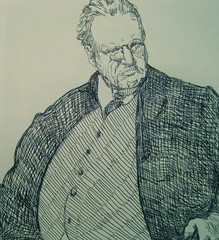
G.K. ChestertonImage by giveawayboy via Flickr
"If there were no God, there would be no atheists." -- G. K. Chesterton.

Of course, without God there would be no creation, and, therefore, being an atheist would not be an option.  But let's suppose there was a universe that was uncaused by a living, intelligent, purposeful, moral being. Would we expect it to look like our universe?

I think not.

We should not expect an uncreated universe to exhibit the order, laws, and exquisite indicators of design, rationality, and moral sense that our universe does.


Related articles by Zemanta
Enhanced by Zemanta

Sunday, September 05, 2010

Stephen and Jane Hawking: Both Sides Now

If you want to know more about Stephen Hawking, you might be interested in reading this article: "Stephen Hawking: the closed mind of a dogmatic atheist. A review of Music to Move the Stars" by Jane Hawking.

This book review talks about Stephen's wife Jane, their life together, his illness, and the care she provided, his rise to fame, his adultery, their divorce, his ardent atheism and her equally ardent Christianity. As usual, hubris tops the list of human sins.

I know little about Jane Hawking, but, based on this short article, it seems to me that she, and not Stephen, may well be the real hero in the Hawking house.

h/t Manawatu Christian Apologetics Society.
Enhanced by Zemanta

Friday, September 03, 2010

Stephen Hawking Jumps The Shark

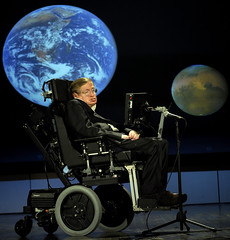
Stephen Hawking NASA 50th (200804210002HQ)Image by nasa hq photo via Flickr
Stephen Hawking jumps the shark:

"Because there is a law such as gravity, the universe can and will create itself from nothing. Spontaneous creation is the reason there is something rather than nothing, why the universe exists, why we exist"  -- Stephen Hawking.

This is the best that one of the greatest minds on the planet has to offer?  Maybe it gets better if you read everything he said; but this is incoherent on about every possible level.

For starters:

* If there is really and truly nothing, then where does gravity come from?

* Why do natural laws exist at all, and why  are the natural laws what they are as opposed to some other thing?  Why, e.g., is there gravity in the first place, and why does it have the strength it has as opposed to some other strength?

* The terms spontaneous creation and reason are incoherent when used together. If creation was spontaneous, then there may be a cause for the universe but there is no reason for it;  reason becomes an incoherent concept and an absurd quest. Spontaneous generation of the universe may explain how we came to exist, but not why -- because there can be no why under this scenario.

Hawking's comment appears to be nothing more than atheist dogma -- "from nothing, by nothing, for nothing" -- in pseudo-scientific drag.

Stephen's wife, Jane, here.

Related articles by Zemanta
Enhanced by Zemanta

Tuesday, August 31, 2010

Quote of the Day: "Those Who are Attracted to Atheism are First Repelled by Theism”

Dr. Alister McGrath poses for a picture while ...Image via Wikipedia
"History strongly suggests that those who are attracted to atheism are first repelled by theism." -- Alistair McGrath.

The Church's message is not, "look at us". It is look at Christ. The Christian's message is not, "look at me". It is look at Jesus.

"Christ as King of Kings". A Russian...Image via Wikipedia
When I became a Christian, it was not because I was attracted to the Church. I did find my New Testament professor an attractive person, but he was the exception. What I was attracted to was the person of Christ. He is the idealist's best friend, and the moral perfectionist's best hope. When I looked at him, the gap between "is" and "ought" made perfect sense.

Dissatisfied with the "is" of your life? Look to the "Ought".

You want to see moral perfection? Look at Christ. You want to see God-at-work? Look at Christ. Want to hear words of wisdom? Listen to Christ. Want to see a man who loves God with all his heart, mind, soul, and body? Look at Christ. Now, look at him on the cross.

Do you want to see evidence of the saving power of God at work -- the power of God to overcome the evil of this life and "make things right"? Look at Christ raised from the dead, ascended, and seated on high. Do you want reason to hope that evil will be finally overcome? Look to Christ, the soon-coming King of Kings and Lord of Lords who will establish the rule and dominion of God on this earth.

Speaking of dominion, do you want to know what Canada's destiny is? "He shall have dominion from sea to sea."

"We preach not ourselves, but Christ crucified".

Enhanced by Zemanta

Thursday, August 19, 2010

Quote of the Day: "There is more to life than the laws of chemistry and physics." -- Scot McKnight

To Kill a MockingbirdImage via Wikipedi
Is atheism "less than there is" -- or is theism "more than there is"?

Is atheism reductionist? Does it fail to recognize layers of explanation?

Is there a direction and a "plot" to the universe, or is the elegant unfolding of the universe since the Big Bang just a crazy outcome of a purposeless explosion?

Scot McKnight reviewing John F. Haught's book  Making Sense of Evolution: Darwin, God, and the Drama of Life:
There is, Haught suggests, a direction and a purpose to creation, but we will not see the intent and direction at the level of chemistry and physics any more than we see the intent in To Kill a Mockingbird at the level of grammar and spelling. Even less will we see the meaning at the level of the chemistry of paper and dyes, the engineering of the printing press, or the materials chemistry behind the electronic ink or electronic paper of a Kindle or Nook or other e-reader....
I am not a theist because I find gaps in the grammar and spelling that require direct action of God - I am a theist because I believe in a plot, purpose, and direction that transcends the nuts and bolts of the grammar and spelling. There is more to life than the laws of chemistry and physics.
How about you -- do you believe in a plot, purpose, and direction to life?

To your life?

Regain your humanity. Make the existential leap. Rebel against the atheist machine.™

Read more.
Enhanced by Zemanta

Sunday, August 15, 2010

Quote of the Day: "I Turned My Back On One Faith And Embraced Another"

Dr. Alister McGrath poses for a picture while ...Image via Wikipedia
My doubts about the intellectual foundations of atheism began to coalesce into a realization that atheism was actually a belief system, whereas I had assumed it to be a factual statement about reality. I also discovered that I knew far less about Christianity than I had assumed. As I began to read Christian books and listen to Christian friends explain what they actually believed, it gradually became clear to me that what I had rejected was merely a religious stereotype. I had some major rethinking to do. After checking out Christianity's credentials and discovering its immense spiritual vitality and intellectual potency, I came to faith in the God whom I had once regarded as little more than an obsolete curiosity. So in the end, I turned my back on one faith and embraced another. -- Alister McGrath

 (Alister McGrath's essay "Challenges from Atheism" in Beyond Opinion: Living the Life We Defend. Nashville: Thomas Nelson Publisher, 2007: 23)
Enhanced by Zemanta

Sunday, August 08, 2010

Seven Empirical Arguments Against the Existence of God


Here's a Wiki list of seven empirical arguments against the existence of God, along with seven lines of response.

1. The argument from inconsistent revelations contests the existence of the deity called God as described in scriptures — such as the Jewish Tanakh, the Christian Bible, the Muslim Qur'an or the Baha'i Aqdas — by identifying apparent contradictions between different scriptures, within a single scripture, or between scripture and known facts. To be effective this argument requires the other side to hold that its scriptural record is inerrant, or at least to assert that a proper understanding of scripture gives rise to knowledge of God's existence.

Refutation: God's existence has no necessary connection with Scriptures, or, for that matter, any human conception of God.

Secondly, just because you have nine counterfeit $100 bills in your hand does not mean that the 10th is also counterfeit. There may or may not be a genuine revelation that points accurately to God.


Thirdly, if God does have a Scripture, it need not be inerrant to serve its intended purpose -- just like a One Way sign can be pock-marked, dented, and rusted and yet still clearly serve its purpose. 


2. The problem of evil contests the existence of a god who is both omnipotent and omnibenevolent by arguing that such a god should not permit the existence of evil or suffering. The theist responses are called theodicies.

Refutation:  Cancer bites. Death bites. Poverty bites. Suffering unjustly bites.  Evil is not just a perception; it is real.  The problem of evil is addressed in the Christian Scriptures from Genesis to in the book of Revelation. We are assured that it exists only temporally, and will be defeated in time.

Secondly, without God as Creator and Law-giver, evil is an incomprehensible, meaningless idea. There can be no evil where there is no good. There can be no good vs. evil where there is no "ought". An amoral atheistic universe does not contain an "ought" as part of the furniture of reality.  We thus find in this argument from evil atheists arguing using assumptions which are only authentic if theism is true.

3. The destiny of the unevangelized, by which persons who have never even heard of a particular revelation might be harshly punished for not following its dictates.

Refutation: Adequately covered in the book of Romans. God judges each man and woman according to their hearts and consciences. The sacrifice of Christ covers the sins of the whole world. God will be just in his punishments and rewards.

The bigger problem is why man should think that life ought to be just at all.  Once again, this is a conception which must presuppose theism to be an authentic issue.

4. The argument from poor design contests the idea that God created life on the basis that life-forms, including humans, seem to exhibit poor design.

Refutation: Once again this is reading-into the definition of God what we think God should be and do.  This argument is linked to the problem of evil -- the universe is not the way we imagine a perfect universe should be. But this leads to another question -- why should human beings be wired with this deep conception of the ideal, or Perfect (and, an "Ought")?  Like other abstracts, these abstracts point to a perfect world, which the Scripture assures us shall be accomplished in Christ. And, like other abstracts, they show that atheists when they argue do so on the basis of presuppositions about reality that are only authentic assuming theism is true.  If atheism is true, not only should things not make perfect sense, they should make no sense whatsoever -- because the very fabric of reality is, under atheism, senseless, and sense-making human beings an absurd anomaly.

A bigger problem is also why an unplanned, unguided, uncreated universe should exhibit any evidences of design whatsoever.

5. The argument from nonbelief contests the existence of an omnipotent God who wants humans to believe in him by arguing that such a god would do a better job of gathering believers.

Refutation: Same fallacy as the other arguments that argue, "if we were God, we wouldn't do things this way". That's a losing argument for reasons cited. God has entrusted the saving word of salvation into the hands of ordinary men and women. And he is using them to propagate his message. It is interesting that in Revelation it says that the gospel shall be preached throughout the world -- this at a time when the Christians were a small, insignificant, beleaguered sect. That statement has been fulfilled.

6. The argument from parsimony (using Occam's Razor) contends that since natural (non-supernatural) theories adequately explain the development of religion and belief in gods,[28] the actual existence of such supernatural agents is superfluous and may be dismissed unless otherwise proven to be required to explain the phenomenon.

Refutation: Occam's Razor is a mere heuristic. One ought not stake one's eternal destiny on a mere heuristic. And it fails in this case because everything requires not just an explanation for its existence but a sufficient reason and cause, and the only sufficient cause for an elegant universe in which morality and rationality are not just subjective feelings or apprehensions but part of the very fabric of existence, is a Creator who is himself both personal and moral.

7. The analogy of Russell's teapot argues that the burden of proof for the existence of God lies with the theist rather than the atheist.

Refutation: Russell's teapot is just the flying Spaghetti monster of old. Refuted here. Such arguments merely point out the desperation of atheism which finds itself resorting to ridiculous caricatures.

An orbiting teapot, unlike God, has no explanatory power.

All things whose existence is contingent, i.e., not necessary, require a sufficient reason or cause for their existence. God provides a complete, full, and satisfactory explanation for the existence of the universe. The floating teapot explains precisely nothing.

In addition, the idea of God resonates in the human heart in a way that teapots and spaghetti monsters do not.  Indeed, belief in God may be properly viewed as basic, as Alvin Plantinga has suggested.

* * *

The problem with empirical arguments is God is an immaterial Spirit who exists apart from his empirical Creation. Trying to disprove God from empirical evidence cannot succeed -- but neither can trying to prove God from empirical evidence succeed, beyond probabilities which will be dismissed by those wishing to do so. So, no one is going to win this argument, and it comes down to, at the end of the day, the disposition of one's heart.

God has set sufficient evidence in place to make his existence apparent;  it is the condition of our hard, bent hearts that resists the knowledge of God. Free-will, contrary to the assertions of strong materialists, is real. It is real because God wants those who will spend eternity with him to freely choose him. For this to be the case, not choosing him must also be a real option. For this ability, atheists can thank God -- they owe a lot to Him.

List of Arguments from Wiki.


Tuesday, July 13, 2010

Does 1 + 1 Always Equal 2?

Das Neue Jahr - fängt gut an ... Hommage an de...   Image by digital cat  via Flickr
I was asked:

*Would you say that 1 + 1 = 2 did not exist before humans discovered it?

I responded: No, but I'm not an atheist. Do you think that 1+1=2 existed before the universe came into existence?

*Joe_Agnost said...  So before humans discovered math, say 1 million years ago, an apple and another apple DIDN'T equal 2 apples??  Of course they did...

Let's consider this, under atheistic assumptions.

There is a universe. It is uncreated. It is mindless. No mind. No consciousness.  A rock rolls down a lifeless Earthscape. There is a rock now lying at the bottom of the hill. Later, another rock rolls down the hill.  There are now the original rock, and the rock that came after it.  So, 1 + 1 = 2, right?

Wrong.

First, the number one is a mental concept, an abstract. It does not yet exist. There is no mind to conceive of it. So, one, as a mental concept, cannot exist. Same for the number two. Abstracts cannot exist without minds to convey them. All we have at this point are rocks.

Second, 1 + 1 = 2 is an arithmetic operation. Arithmetic operations require minds to both conceive of them and perform them. Minds have not yet been "invented" by cosmic evolutionary processes.  So, 1 + 1 = 2 is an incoherent, meaningless statement. It is impossible for 1 + 1 = 2 to exist where there is no mind to instantiate it.

The theist, of course, believes that there has never been a moment in reality when Mind did not exist and 1 + 1 did not equal 2. So, the theist can confidently assert that, yes, 1 + 1 = 2 before humans "discovered math".  (Notice Agnost's word "discovered", not "invented".)  The theist can also confidently posit that 1 + 1 = 2 before this universe was created, and that 1 + 1 = 2 not only in this realized universe, but "in all possible worlds".

As I said in a previous blog, I don't think we realize what a great role the assumption of mind plays in our apprehension of reality, nor do we realize what a mind-boggling idea it is for the atheist to think that there was a time in the universe when mind was not, and things like numbers, abstracts, beauty, etc. did not exist and then came to exist as minds emerged from mindless slime.

Regain your humanity. Rebel against the atheist machine.™
Enhanced by Zemanta

"... nothing intellectually compelling or challenging.. bald assertions coupled to superstition... woefully pathetic"